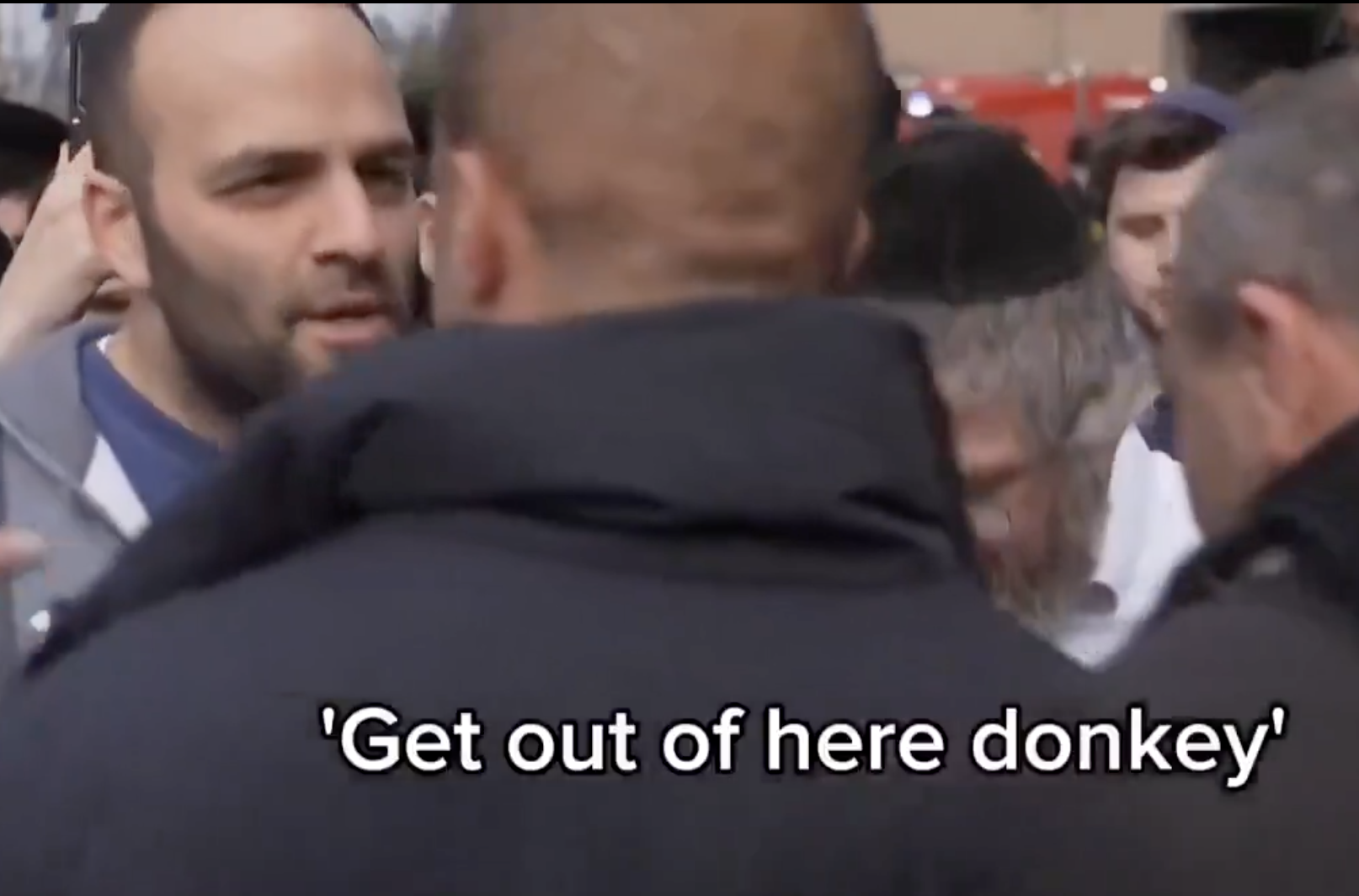
David Soffer, a Metropolitan Police Special Constable, was filmed in Golders Green haranguing a journalist. He was part of a crowd that surrounded the Al Jazeera journalist who had come to report on the March 23 arson attack in which four ambulances were burned. The arson has been categorised by the Metropolitan Police as a hate crime. .
Reports of the altercation quote Soffer as calling the journalist a ‘dog’ and telling hin to ‘go back to Qatar’. Soffer is also said to have retweeted an offensive post about Gaza.
Declassified UK website reported that, in 1924, Soffer had retweeted a post by far-right activist Steven Yaxley-Lennon. Yaxley-Lennon, who likes to use the name of a football hooligan,Tommy Robinson, as one of his many aliases (presumably to cutltivate a ‘tough’ image), posted on Twitter saying “Fuck Palestine”. He added “The shithole is full of inbred Islamist parasites and terrorists.” Soffer responded, saying that Robinson “is telling the truth”.
One journalist, Matt Kennard, commented ‘Imagine if a Muslim off-duty police officer called a Jewish Chronicle reporter a “dog” and told them to “go back to Tel Aviv”. Would be front-page of every major newspaper. Starmer would have to make a statement. Let’s see if it’s even covered at all when it’s this way round…’
Soffer is also reported to be involved in a ‘reputation management’ company. You have to wonder what reputation he was trying to manage when he got involved with the mob that intimidated journalists. We will wait to see what action the Metropolitan Police takes against a pro-Israeli activist who intimidates journalists.
The latest news from the Middle East is there has been a huge terrorist attack in Iran earlier today.
The leader of the terrorist organisation behind the attack, Donald J Trump (also known as Terrorist Warmonger Trump) has taken to the air to claim responsibility for the attacks in which hundreds of people have been killed. The victims of this attack include Ayatollah Khamenei, the cleric who ruled Iran for the last thirty years.
Western political leaders have been quick to NOT condemn this action as a ‘cowardly attack’ and as a ‘breach of international law’. Prime Ministers and Presidents who have, for years, talked about the ‘rules based international order’ are uncharacteristically silent.
Preliminary reports indicate the murder of Khamenei was carried out by a Trump-affiliated terrorist organisation based in Tel Aviv and jerusalem – the Israeli government.
The most recent scandal to befall Little Lord Mandelson is the revelation that he and his husband, Reinaldo Avila da Silva, allegedly received about $75,000 from Jeffrey Epstein. The evidence for the transactions, comes from documents released by the US Department of Justice.
The documents, which are about transactions alleged to have occurred 20 years ago, seem to indicate Epstein transferred 3 payments of $25,000 over a few months to Mandelson da Silva, who was Mandelson’s boyfriend at the time.
Mandelson’s ‘denial’ or his immediate reaction was to state that he had no recollection of the transactions, and to question whether they were genuine bank documents. He suggested the bank should be asked to verify the accuracy of the documents and suggested he needed time to check his own records.
This comes on top of the reports that Mandelson’s boyfriend received a ‘loan’ of £10,000 from Epstein to fund a training course to become an osteopath.
What is striking about Mandelson’s rebuttal of the allegations is how indecisive they are. He needs to check his records. He wants the bank to confirm if the documents are real. But what is omitted from his response is an unequivocal assertion that the transactions never happened. Any ordinary person would probably have no trouble rmembering that they never received tens of thousands of pounds in gifts. I know I would have no trouble answering an allegation that someone had sent me, or my partner, £75,000. Even if the gift was 20 years ago. But then for me, and all the people I know, gifts of tens of thousands of pounds are the exception, not the rule.
The allegation and Mandelson ‘s prevarification, give us a glimpse into how the ruling class works to corrupt the politicians elected by the working class. We know about the jobs-for-the-boys arrangements that reward former government mimisters who have served the interests of the ruling class. Mandelson’s sleazy relationship with Epstein illustrates the ‘gifts’ and ‘loans’ made to influential politicians. The gifts and loans are made with implausible deniability. Of course `Mandelson will deny that Epstein was buying influence. The working class will drawe its own conclusions.
The alleged gifts were made when Mandelson was serving MP and the Labour government was under pressure to limit the system of financial bonuses for bankers and financiers. Epstein made it perfectly clear what he thought of limiting those bonuses.
The capitalist press will focus on Epstein’s sexual predation and his conviction for sex-related offences. But the bigger picture is not whether mandelson received money from a convicted paedophile and traficker. The question is why he received any money from anyone. The scandal reveals how the capitalist class uses their money to influence politics. In a system of one person one vote, they want us to believe we are all equa. The reality in a capitalist society, is that real power belongs to the rich.
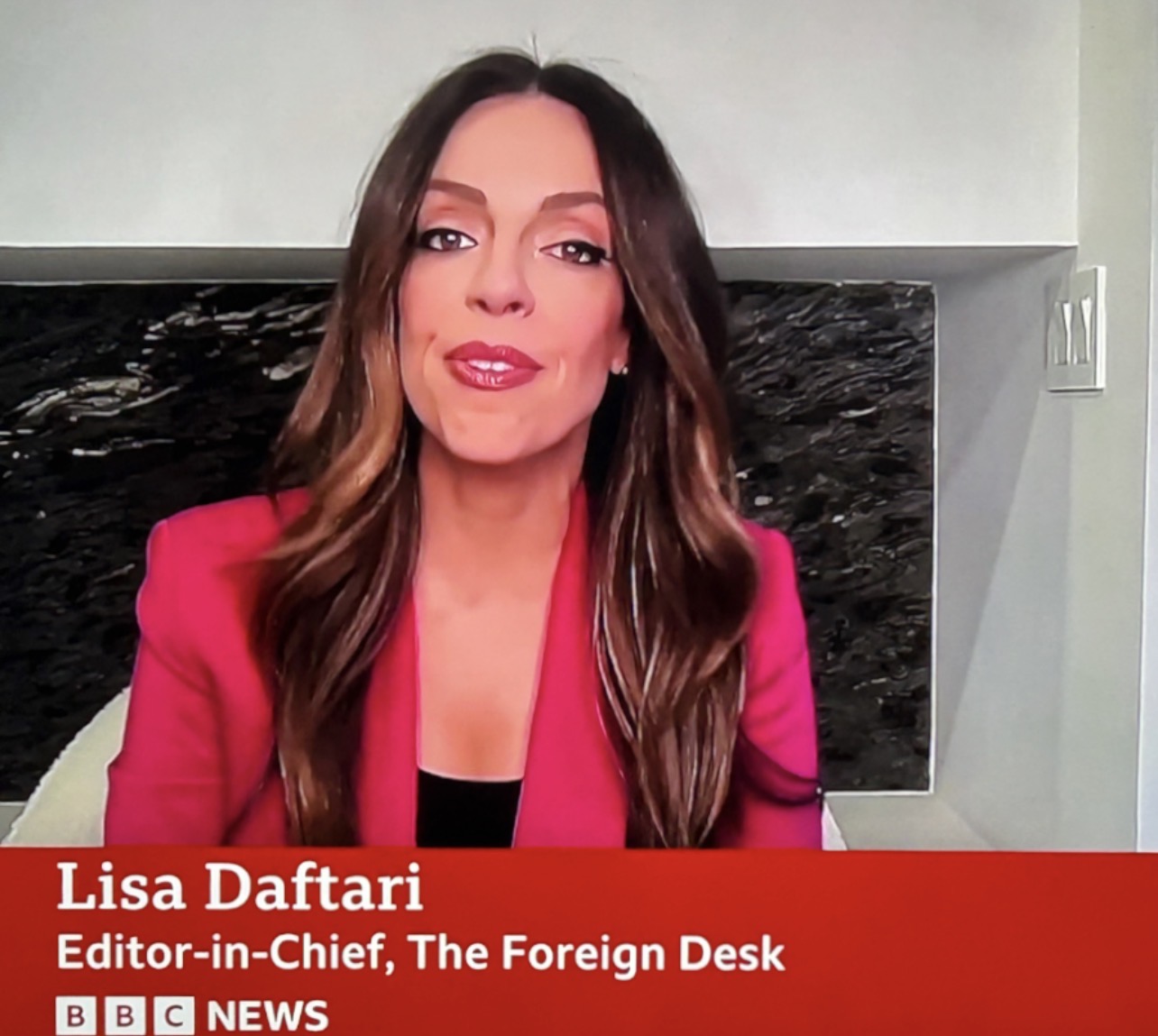
Today BBC News provided a platform for Lisa Daftari, an apologist for the Iranian military dictatorship which preceded the Islamic Republic.
In an interview on the BBC News channel today, Daftari sang the praises of the Shah of Iran’s regime. She argued that ‘millions’ had taken part in the current wave of unrest and demonstrations in Iran, and the majority of slogans at the demonstrations were in support of Reza Pahlavi, the son of the former dictator.
The interviewer, Carl Nasman, allowed her to continue with her assertions unchallenged. Eventually he suggested the Pahlavi regime had not been democratic.
Daftari’s response was to describe the dictatorship of the Shah as ‘a utopia’ compared to the current regime. The utopia claim went unchallenged.
The facts about the Shah’s dictatorship are undisputed.
The self-titled Shah of Iran, came to power in a coup that overthrew a democratically elected regime.
The regime he overthrew nationalised Iranian oil assets, taking control from foreign oil companies.
The coup was actively backed by British and US intelligence services.
During the Shah’s dictatorship thousands of political opponents were routinely killed or tortured by his secret police, SAVAK.
SAVAK extensively monitored the activities of Iranian students and others living abroad, creating a climate of fear. Students and other Iranians living abroad were terrified they would be arrested and tortured or killed, when they returned home.
The facts show the Shah’s regime was one of the most brutal regimes of oppression.
Lisa Daftari has a strange idea of what utopia means.
And the BBC claims to report the facts without bias.
Today on BBC Radio 4 Alan Milburn was being interviewed. The host said he was a former Health Secretary in the Labour government, and was now working for a private health consultancy.
Well knock me down with a feather! #jobsfortheboys
A quick internet search reveals Wikipedia has him listed as a consultant to Price Waterhouse Coopers while holding another appointment at Bridgepoint Capital and all while being a member of the Healthcare Advisory Panel at Lloyds Pharmacy.
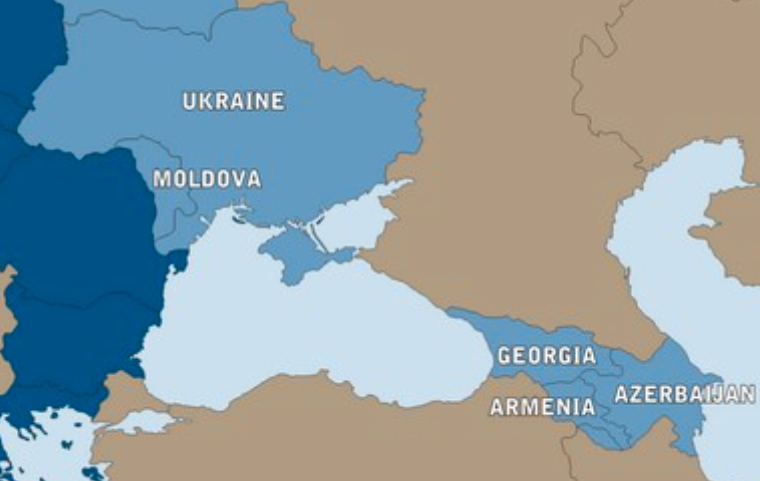
On 8 July 2022 The Economist set out its explanation of why Georgia had been denied candidate status on the same day Ukraine and Moldova were granted their candidacy, on 23 June 2022.
The Economist explains the failure by uncritically repeating the EU’s explanation. But the EU’s real reasons are not necessarily the reasons they give for their actions.
In 2014 all three countries signed association agreements with the EU. The Economist omits to explain the difference between an ‘association agreement’ and ‘candidate status’ but they are essentially steps along the same path. The EU expects countries seeking membership to demonstrate a stable bourgeois democracy and also have a reasonably strong economy. If the applicant is deemed to meet their criteria they are granted candidate status. If not they draw up an association agreement setting out what changes the EU requires before they can become candidates.
Moldova, Georgia and Ukraine are former Soviet states and all three were subject to the same economic anarchy that enabled powerful individuals to seize the assets of the people at a tiny percentage of their true value. This was achieved primarily through the corruption of the government bureaucracies who were bribed or co-opted into the new capitalist entities that took over the state assets. In many cases the corruption was at arm’s length. The co-owners of the massive new enterprises were often the family members of the people who actually wielded the power.
The problem Georgia faced with it’s candidacy was its failure to ‘de-oligarchize’. This is a term used by the EU to stigmatise the obscenely rich individuals who own and control Georgia. They cite Bidzina Ivanishvili as an example of type of oligarch whose influence needs to be restricted. And like many oligarchs in the states of the former Soviet Union, he uses proxies to do his dirty work. The trouble with the EU’s concerns about oligarch power in Georgia is their failure to show the same concern about oligarch power in Ukraine and Moldova.
The Economist let’s slip the reason behind the EU’s selective blindness. ‘Russia’s relationship with Georgia will also be on the minds of EU leaders’ we are told. Of course it will.
Ayesha Hazarika’s advice in her Evening Standard column echoes what many political commentators have suggested.
From their point of view neither Jeremy Corbyn nor Boris Johnson are suitable prime ministers. But one of them is going to win, so you have to choose the one you least dislike.
I am not convinced.
For nearly forty years I abstained in every election because I did not think it made a difference. When New Labour was born, I felt my abstention had been vindicated. Here was a leader, Tony Blair, who was so similar to the Tories you could not separated them with a cigarette paper.
But then came theEU referendum. I was back. Here was a vote in which my vote counted. I could make a difference. The choice was simple – Leave or Remain – and whichever side won, their decision would be implemented. So I voted to Leave.
How naive I seem now.I was wrong. The most basic student of Marxism could have told me why. There is a reason why they call it the dictatorship of the bourgeoisie. They don’t need jackboots and detention camps to exercise their power. They do not need to scrap parliament and dismantle the facade of democratic control. When you hold all the levers of power, the facde of a democratic referendum is an obstacle you can overcome.
So the machine rolled into action. For three years we heard an almost constant refrain of how we had got it wrong. First we were stupid or ignorant. Initially they reassured us they would still respect our decision. Every political discussion started with “Of course we respect the result of the referendum, but…” In the immediate aftermath of the biggest democratic kicking the ruling class have received since the 1945 election, it could have provoked a revolution (what they like to refer to as civil disorder) if they had simply slapped the working class electorate in the face at that point.
So they do what they know best. Kick it into the long grass. Delay. Shilly-shally. Drag it out in the hope the public would lose interest. And start the high-powered propaganda campaign to overturn the result.
The first prong of the attack was that we did not know what we voted for. Hard Brexit? Soft Brexit? But our self-appointed leaders of public opinion would sort it out for us. Every variation of Brexit was discussed, with a constant refrain in the background saying – see, it is more complicated than you thought.
After a year or so they moved to stage two of the campaign – the call for a ‘second referendum’. Of course that would be complicated too. We would need a three-way vote. Remain, Leave outright or accept some compromise deal. Keeping Leave on the ballot paper was a reluctant concession. But they still lacked the confidence to declare their intention to ignore our vote.
Finally after a three year war of attrition, the second referendum or People’s Vote morphed into a confirmatory referendum. The difference between the terminology is important. The crucial difference between a second referendum and a confirmatory vote is the disappearance of the Just Leave option. A confirmatory vote is a choice between staying in the EU and whatever deal the government of the day has negotiated. The option to Leave outright has just been dropped. Maybe they thought we would not notice.
This ‘confirmatory referendum’ was originally mooted when the deal on offer was Theresa May’s withdrawal agreement a deal which was almost universally rejected. So a confirmatory referendum at that point seemed an easy win for the ruling class’s preferred option – Remain. This has been complicated somewhat by the new Tory PM’s deal, which has a better chance of winning in a second vote.
The general election has been presented as a kind of second referendum. Giving the Tories a majority makes the Boris deal a shoe-in. Giving Labour a majority makes a confirmatory vote a shoe-in. And Labour have volunteered to load the dice even more heavily in favour of Remain by saying they will renegotiate a withdrawal agreement which will so closely resemble the Remain option as to make voting for it an almost pointless exercise.
But framing the general election as a second referendum is complicated. A general election is never a single issue decision – it cannot simply be about Brexit. The election also determines the economic and social policy of the next government. That is why Ms Hazarika and others want us to hold our noses and vote Labour.
They want both left wing Leave voters and left wing Corbyn haters to vote Labour – a Remain party in all but name – to keep out the Tories.
My answer to Hazarika and Co. is this. I came out of political abstentionism to participate in this farce. And Leave won. If your party cannot implement that decision then your party does not deserve my vote.
I am not going to ‘hold my nose’ and vote for a party that stinks. I would rather not vote than give my support to a political process that demonstrates its contempt for the democratic decision of the working class.
I have been looking at several left-wing websites, hoping to find a rationale for the position I have decided to take. And I do not see it.
They all want me to vote Labour. Some say put them in power to demonstrate to the working class they are not truly socialist. The argument goes that Corbyn and McDonnell will talk the good fight, claiming to be radical socialists, until they are put on the spot. Others seem to be taken in by the left-wing credentials of Corbyn, and see him as a genuine left-wing alternative to the status quo. And others, more desperately, cling to the argument that failing to vote for Corbyn is tantamount to voting for another 5 years of Tory austerity.
I am sorry, but I do not buy it.
Maybe I overestimate the working class. But if the last 3 years have achieved anything, it is to focus our minds on the contrast between what we vote for and what we get.
We can vote to Leave the EU. But what we get is a concerted campaign to overturn that decision. And the leadership of the Labour party has been complicit in that betrayal. Not just Starmer and Watson and Thornberry, but Corbyn too. And his erstwhile partner in arms, McDonnell, has made the most enthusiastic volte face of all.
If Corbyn was a principled socialist, he would have stuck to his guns and argued openly for the Labour Party to campaign against the EU. Like the parliamentary manoeuvrer he is, Corbyn weighed up the pros and cons of sticking to his principles, and decided he should jettison them. He chose to curry favour with the anti-Brexit membership of his party. Campaigning against them would have jeopardised his position as leader. So he went with the flow.
My first instinct, when the election was announced, was to abstain. There is no party standing which represents my position. So there is no party that gets my vote.
I think this is a position which is shared by millions of workers across the country. We want to support a party that would implement the type of policies the Labour Party claims to support. But we do not trust Corbyn to put those policies into practice.
If, after decades of anti-EU activism, he caves under the pressure of the last three years, what hope is there that he will implement genuine anti-capitalist policies?
So I will abstain.
Until there is a party in which I can place my trust, nobody gets my vote.
The Ukrainian presidential elections resulted in a TV actor beating the incumbent (Petro Poroshenko) and a third-time candidate for president (Yulia Tymoshenko) into second and third places, respectively.
The first round of the Ukrainian elections was won by Volodymyr Zelensky, an actor, with no previous political experience – unless you include playing an anti-corruption campaigner who becomes president in a satirical TV show.
The election of Zelensky is yet another sign of the willingness of the working class to stray from the well-worn path the ruling elites would have them follow. Zelensky, however, is no anti-corruption superhero. His campaign was supported and partially funded by one of the many oligarchs who use their financial clout to try and wield political power in Ukraine. This support from Igor Kolomoisky, who owns a Ukrainian TV channel, casts a shadow over Zelensky’s anti-corruption credentials.
The incumbent president, Petro Poroshenko, is himself a chocolate magnate and ranks among the wealthiest people in Ukraine. And Yulia Tymoshenko, the former prime minister and presidential candidate, was at one time one of the richest people in the country as a result of her activities in the gas industry.
The rejection of these establishment characters by the Ukrainian working class is an indication of their growing impatience with the high-level corruption in Ukrainian government circles. The fact that they would rather vote for a TV comedian than their current president or their former prime minister is a measure of the contempt felt by ordinary working people for the political elite.
For a truly effective anti-corruption regime to be established in Ukraine they may need to return to the soviet election system, as it was first established in 1905 and 1917 – in which elected representatives do not serve a fixed term but can be recalled and forced to stand for re-election by their constituents at any time. Putting political power back into the hands of the working class, as it was briefly following the successful Russian Revolution of 1917, is a big step, and will require more than the current protest vote for Zelensky. He is not the saviour he portrays in the television series.
Taking political power into the hands of the working class will require a social revolution, and the expropriation of the oligarchs who have been robbing the country for decades. Ukraine is in a uniquely fortunate position as the social ownership of the country’s greatest manufacturing assets is a recent memory for the working class. But it will require democratic workers’ control those assets to prevent them becoming under the control of a political bureaucracy with its own agenda.
Who says the BBC’s World Service, which is part-funded by the British government’s Foreign Office, is biased?
Today the radio service reported on 2 demonstrations in Venezuela – one pro-Maduro and one pro-Guaido – which took place in different areas of Caracas. The emphasis of the report, by Will Grant, was on the grievances of the anti-Maduro demonstrators. His opening remarks were to state the words that he heard the anti-government demonstrators use. Followed by the statement; “This was a day of opposing marches – demonstrations at two different ends of the city, reflecting two starkly different visions for Venezuela.”
We were left to assume the two demonstrations were equal in size. There was no reference to the numbers of demonstrators. Perhaps they were about the same size?. How would we know? Will Grant wasn’t going to tell us. But a few clues came out of his report.
“When the man they want to replace President Maduro arrived – Juan Guaido – he addressed them by megaphone,” reported Grant. A megaphone! Take a moment to think about that fact. He addressed this (massive?) demonstration with a hand-held megaphone.
Grant went on to report Guaido told the demonstration “He would travel the entire country with members of the National Assembly and bring people back from the provinces for another big demonstration in Caracas.” You might think that sounded like a leader trying to give hope to disappointed supporters at a small demonstration. If you thought that, your conclusion could only be reinforced by the words of one of Guaido’s supporters, Manolo, who told Will Grant,
“Every minimal advance is very, very important – every display of popular unity – every display in the streets. This dictatorship won’t be forced out overnight. It will take a lot of work. They are deeply entrenched in power. They have the police, the army, the guns. We are just working people. But although it might look small, it all adds up until we reach our objective of getting out from under this government.”
So even according to one of Guaido’s activist supporters the demonstration Will Grant was reporting “might look small”. It might look small indeed, but you would have to read carefully between the lines of the BBC report to glean that information.